How We Think About AI
Mike Joyce + Alex Finnemore · Goose Group · Goering Center · April 24, 2026
We build with AI. This is what we've learned.
We run a small studio. We build custom AI software and help mid-market businesses figure out where AI actually creates value. We work with companies between $50M and $2B — manufacturers, retailers, field services, consumer brands.
The work has changed how we run our own company too. We are small by design, but AI lets a small senior team carry more surface area than used to be reasonable.
Goose Group is also the test case.
We don't have a department for every function. We build tools around the work: research, briefs, proposals, code, deployment, customer context, and follow-up. The point is not to replace judgment. It is to make our judgment travel farther.
That is the pattern we keep seeing in our customers too. The best AI work is not a feature sitting off to the side. It is leverage wrapped around real operating knowledge.
Small teams can now do custom work that used to require much larger organizations.
Here is the impact we are seeing.
Custom becomes viable
Specific workflows that never justified a software project can now be built in weeks.
Small bets matter
The ROI does not need to come from a transformation program. It can come from removing one expensive bottleneck.
Builders compound
Enable the people closest to the work, and each useful tool teaches you what to build next.
That is the thread through the rest of this deck: workflows, proof, enablement, and operating leverage.
The real shift is that specialist boundaries are getting softer.
For years, companies organized around scarce skills. Software lived with engineers. Analysis lived with analysts. Reporting, automation, design, and workflow change all moved through specialist queues.
AI changes the scarcity. Generating software, analysis, and structured output is suddenly much cheaper. That doesn't eliminate specialists — it changes where they create leverage, and it rewards people who can move across functions with judgment.
The operating structure built around expensive development resources has to adapt.
Where to start: start by starting.
Step one
Find a process that's very human-driven. Build something small that creates value quickly. Don't commission a strategy — ship something useful and learn.
Then the harder question
Now that you've freed up capacity — how else can you serve your customers in new ways? That's where the real value lives.
Don't start with "what chatbot should we build?"
Start with the workflow. Where does work get stuck? Where is judgment trapped in one person's head? Where does information move too slowly between systems, teams, or customers?
Usually weak
A standalone chatbot people have to remember to visit.
Usually valuable
A workflow machine that extracts, checks, routes, summarizes, decides, and hands off at the right moment.
The hard job is product management: choosing the inputs, the judgment points, the failure modes, and the human controls.
When the problem is specific to your business, SaaS won't fit. Custom is now viable.
Motz was hitting scaling ceilings across sales, maintenance, and field ops. They were curious about AI. We assessed the business, identified where pain was highest, and helped them ship a custom system in weeks that replaced a fragmented process spanning 25+ employees.
Customers started getting instant confirmations. Scheduling moved from one person's head to a shared view the whole team trusts.
Four weeks from Excel to shipped software.
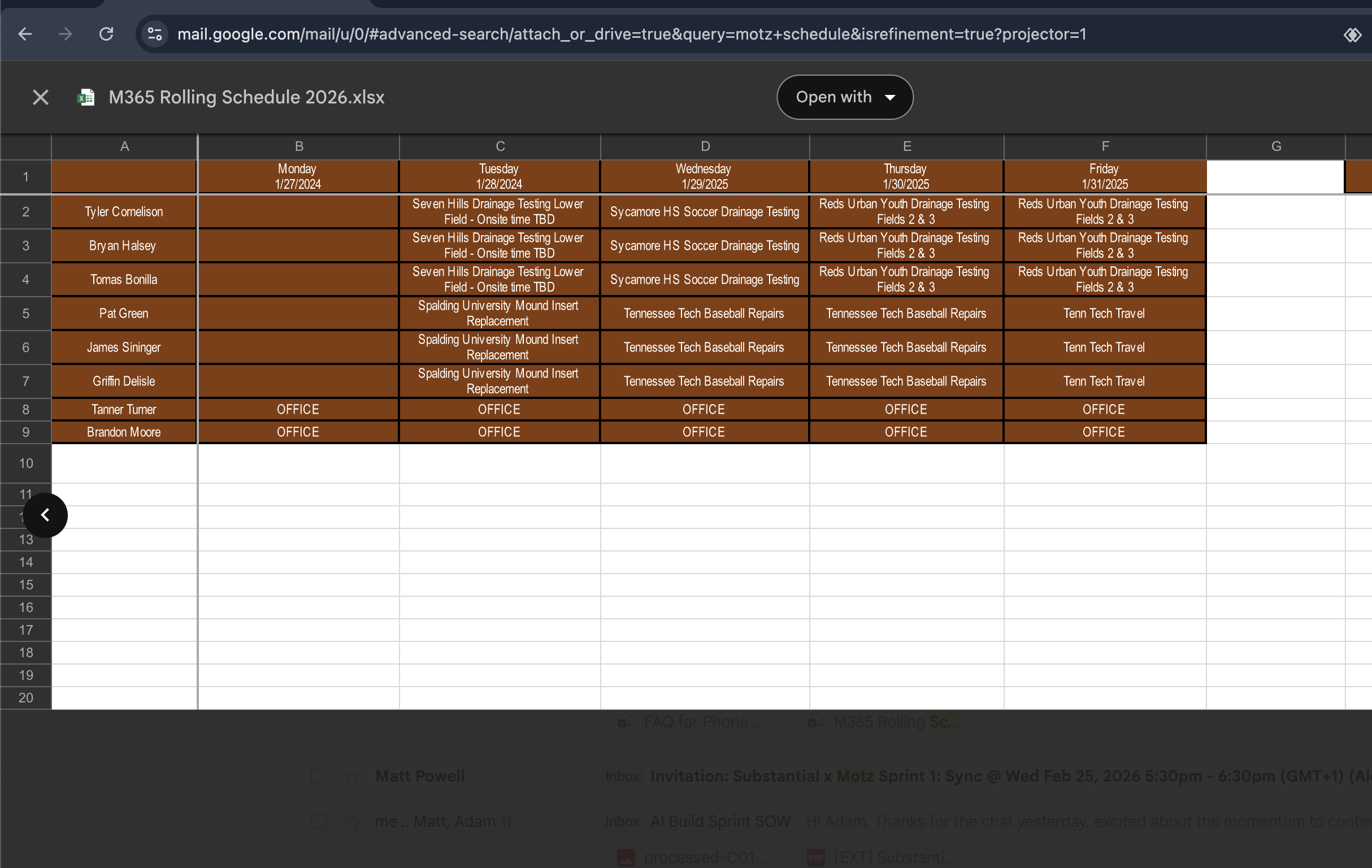
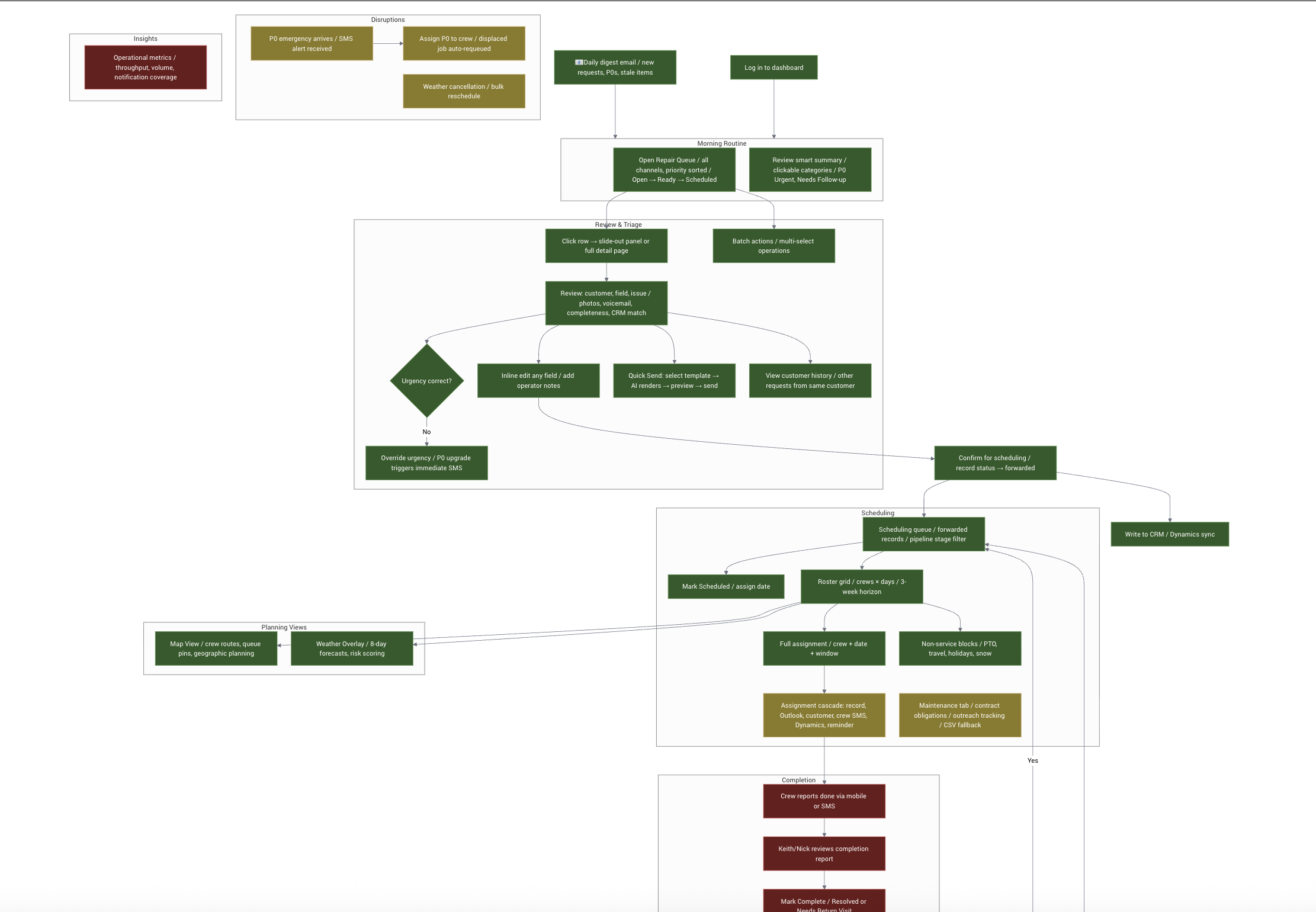
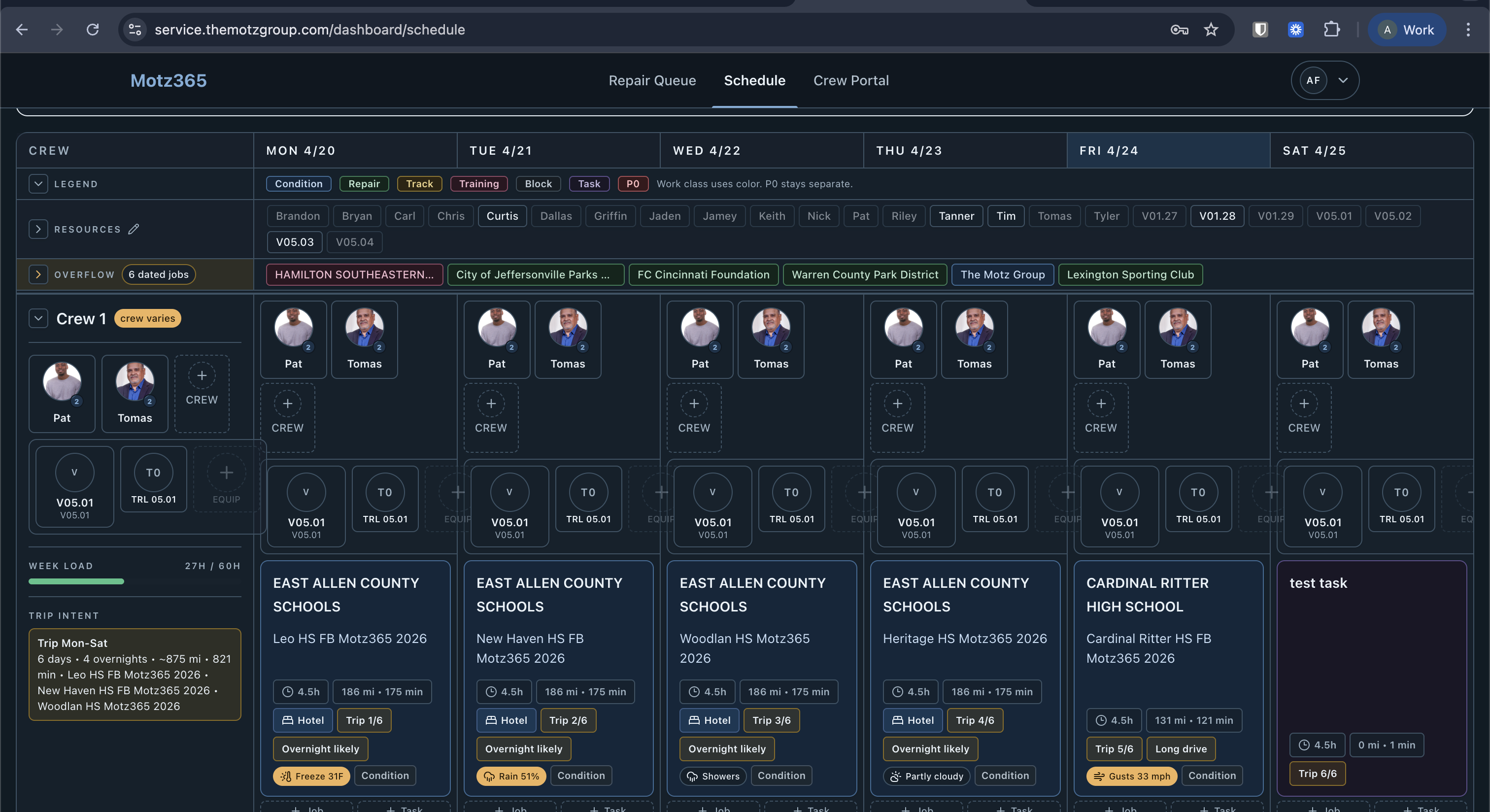
When the tools you bought don't match the workflow you actually run, rebuild the 20% that matters.
A $300M seasonal retailer had a strong tech stack — Snowflake, Claude, ChatGPT, multi-agent QA. But during their 6-week peak season, decisions that needed to happen in minutes were taking days.
flowchart LR
    S["Signal
(live in Snowflake)"] --> X[Excel export]
    X --> P[PowerPoint deck]
    P --> M[Meeting]
    M --> A["Action
(days later)"]
The data was real-time. The decision was not.
Don't wait to clean all your data before doing anything with AI.
Run light use cases first. They tell you which data actually matters. The sequential "data cleansing roadmap" takes years and stalls.
At the same retailer, two teams used different revenue definitions during peak season. Hours of argument instead of action. Natural language over the data warehouse would have resolved it in seconds and freed the executive team for actual decisions.
Agents work well for narrow, repeatable tasks. Not ready for open-ended business judgment.
Good for: triage, extraction, routing, compliance checks. Clear inputs, clear outputs, bounded scope.
The technology is moving fast, but the honest answer today is: useful in specific places, overhyped in general.
Bet on agents for bounded tasks. Keep humans in the loop for judgment.
The tooling path compounds.
Most teams start with chat because it is the easiest way to build literacy. That is fine. But the value keeps moving closer to the work.
1. Chat
People learn what the models are good at.
2. Copilots
Power users move into agents, CLI workflows, and task-specific helpers.
3. Tools
The useful patterns become shared tools wired into real data and workflow.
4. Factory
Each build makes the next one cheaper, safer, and more specific to the business.
The investment is not one tool. It is the capability to keep building useful tools.
Governance is the wrong frame. Observability is the right one.
Governance asks: how do we put people and work back in boxes. You can't. These tools are already in your people's hands. Your executives probably already have Claude or ChatGPT licenses — some of them are building things quietly.
The answer isn't tighter control. It's transparency: who's using what, what data moves where, what decisions got made with AI in the loop. That gives you accountability, but it also gives you signal.
Once you can see where the energy is, you know who to enable, which patterns to make safer, and where the next small build should go.
Loose rollout builds literacy. Observability turns usage into signal. Enable what works.
The most valuable people become systems thinkers.
The job is no longer just doing the task. It's understanding the task deeply enough to shape the machine around it: what inputs matter, where judgment belongs, what should be automated, and where a human needs to stay close.
That starts with customer understanding. Who does this work serve? What do they need faster, clearer, or with less friction? The best operators will keep asking those questions, then assemble tools, data, workflows, and AI around the answer.
Roles don't disappear. They evolve toward designing and managing the systems that make the work better.
That changes the hiring profile.
The people who compound are T-shaped: deep in one discipline, credible across several. A marketer who can prototype. An ops lead who can query the warehouse. An engineer who can write the business brief.
The "manager of specialists" layer gets thinner too. What's working in mid-market is closer to player-coaches: people who do the work, set the standard, and help others use the new machinery well.
Specialists still matter. They're just no longer the only path through the work.
The leverage is in the connective tissue.
Most companies already bought the parts
Data warehouses. CRMs. ERP. BI. AI licenses. Project tools. The stack keeps growing, but the work still falls between systems.
The missing work is assembly
Configure what you own. Build the small bridges. Put judgment where it belongs. Turn a set of tools into a machine that gets data to decisions and decisions back into the workflow.
Buying tools is easy. Assembling the operating system is where the advantage is.
AI makes more specific customer bets worth making.
When software was expensive, every system had to justify itself by serving a broad internal audience. Now smaller, sharper tools can pay back because the build cost is lower.
That changes the strategic question. Not "what generic AI capability should we have?" but "who are we exactly right for, and what could we now do for them that used to be too expensive?"
The advantage is not having the most AI. It is using AI to serve your specific customers better than anyone else can.
Think of AI investment like venture investing, not capex.
Small bets
Short cycles, bounded spend.
Ship something specific in weeks, not a six-figure program in quarters.
Outcomes, not efficiency
New ways to serve customers. New markets. Things that were too expensive to try.
That retailer's six-figure compliance hire became a build that compounds with every new partner.
Velocity over orchestration
The opportunity cost of giving up carefully-orchestrated roadmaps is more than offset by the velocity you get back.
The cost of trying is now low enough that not trying is the risky choice.
The best buy-in comes from a shipped result, not a strategy deck.
Build something small that works. Show the executive team a live demo. Let the proof do the persuading.
The first build is also the business case for the second.
Open discussion.
What are you seeing in your own businesses? What questions would be useful to talk through?
Mike Joyce · mike@goosegroup.co
Alex Finnemore · alex@goosegroup.co
goosegroup.co