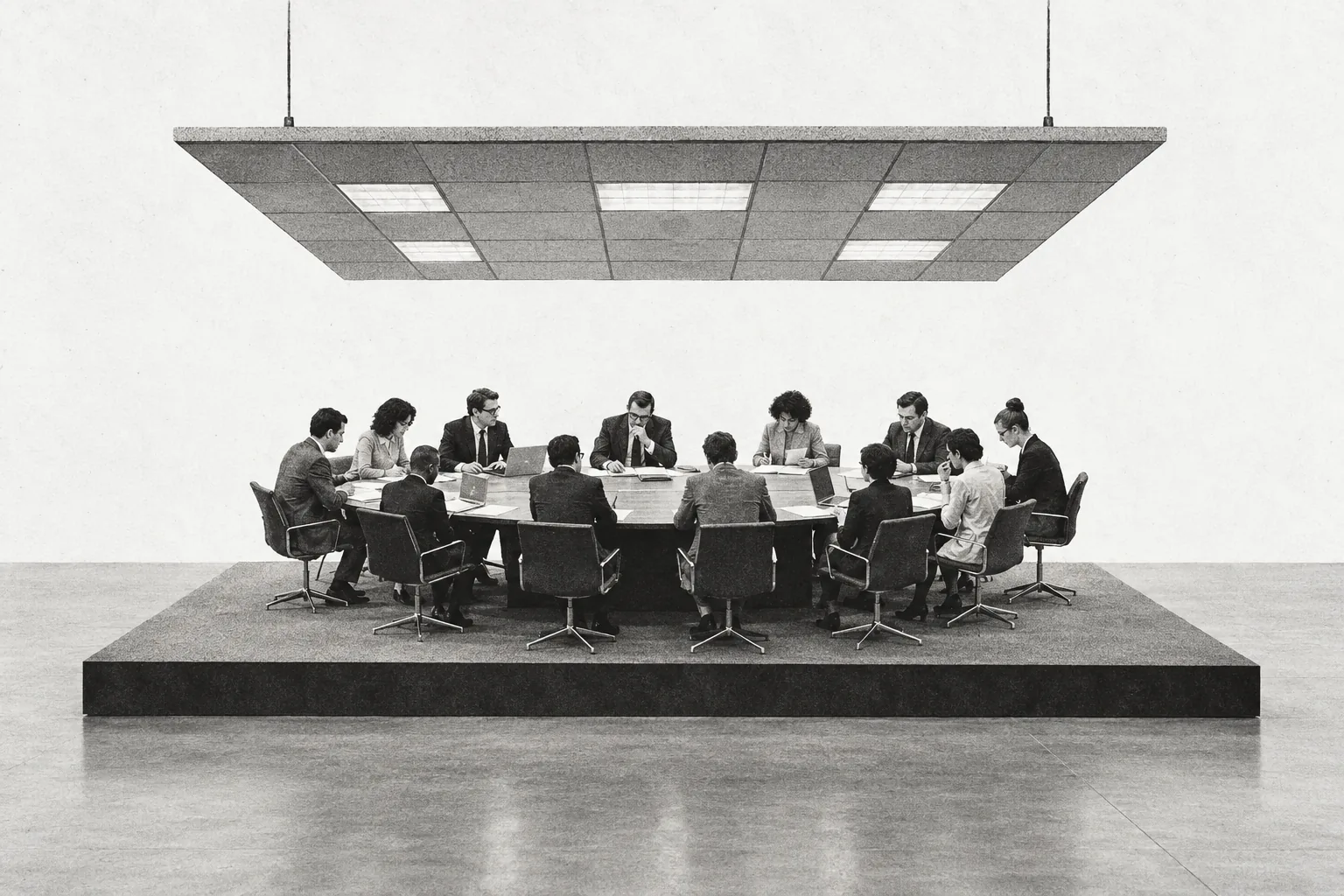
We Turn AI Ambition Into Operating Capability.

Goose Group is a fractional VP of AI partner for companies with real workflows to improve. We work with leaders and operators to find where AI matters, build the first useful tools, and leave behind a repeatable way to keep going.

Not a workshop. Not a tool rollout. Not a deck about the future. We help you create the capability to keep finding, building, and governing useful AI work inside your business.

How we work → | Read the POV →


What Goose Group Is

We sit between executive mandate, business workflow, and technical delivery.

Your leadership team knows AI matters. Your people already see places where work could be better. Your technical teams have real constraints and a long queue. The missing function is often not another platform. It is senior product judgment, AI fluency, and hands-on build capacity focused on turning scattered opportunity into durable operating capability.

That is the role we play. Fractional AI leadership, delivered through working software, operating rhythm, and capability transfer.


How We Help

Found an AI Center of Excellence

For executive teams with AI energy across the company and no clear operating home. We design and run the founding period: intake, cohorts, workflow diagnosis, prototypes, readouts, knowledge base, and the internal owner who carries it forward.

COE model →

Build Pipeline Capabilities

For operational and technical leaders who see friction inside a high-value business flow. We pick one important slice, model the work, build a human-in-the-loop tool, measure it with real users, and decide what deserves the next investment.

Build sprint →

Create Internal AI Operating Layers

For agencies, studios, and expert teams whose work lives across projects, folders, calls, decks, and people's heads. We build the project memory, context systems, internal tools, and AI access that make the team faster without forcing a generic platform on them.

Agency partner →

Find The First Useful Thing

For teams that know the opportunity is real but do not know where to start. We map workflows, identify concepts, validate the strongest with working artifacts, and turn the result into a practical roadmap.

Strategy sprint →


The Work Has A Simple Recipe

  1. See the work. Sit with the people doing it. Map the handoffs, systems, rules, judgment calls, delays, and customer consequences.
  2. Choose the capability. Find the smallest useful thing that would make the workflow better and teach us what to build next.
  3. Build with real users. Put software, agents, prompts, pipelines, or prototypes into the workflow quickly. The review is usage, not a final presentation.
  4. Make it governable. Add the operating structure around what works: ownership, intake, readouts, source control, logs, documentation, and decision gates.
  5. Transfer the pattern. Leave behind people, tools, and playbooks so the capability persists after us.

The output might be a COE, a production pipeline, a project-intelligence layer, a customer-facing tool, or a set of internal playbooks. The shape changes. The operating pattern stays the same.


Who Recognizes The Problem

The CTO or product leader looking at a messy customer-intent-to-production workflow and thinking: there is a product in here, but we need to prove the first slice without turning it into a year-long platform program.

The executive sponsor seeing AI experiments across the company and thinking: the energy is real, but it needs structure, visibility, and a way to turn motivated people into trained internal operators.

The agency or studio owner whose team is carrying valuable client context in calls, spreadsheets, file systems, and individual memory, and who wants that knowledge to become an operating advantage.

If that is you, the first conversation is not about buying a system. It is about finding the first capability worth building.


Why We Think This Works

Our point of view is simple: AI changed the economics of software, but it did not remove the need for judgment. The winners will not be the companies with the most pilots. They will be the companies that turn judgment, workflow knowledge, and customer understanding into reusable capability.

  • Taste as Infrastructure — AI only differentiates when it carries a point of view. Encode judgment so teams can reuse it in tools, workflows, and decisions.
  • Capabilities, Not Systems — Start with small useful capabilities that amplify people in existing workflows before committing to large systems.
  • Useful, Not Done — Useful is a better milestone than done. Ship small improvements, learn from real use, and compound.
  • Primitives Over Platforms — When AI lowers the cost of engineering, durable cloud primitives often beat rented abstraction layers.

All beliefs → | The 90% Threshold → | Observability Is the New Governance →


What It Feels Like To Work With Us

  • Embedded. We work in the actual context: your workflows, your examples, your systems, your constraints.
  • Senior. You get people who can talk to executives, operators, and technical teams without translating through layers.
  • Practical. We build the first useful version fast, then let real use tell us what deserves more investment.
  • Transferable. You own the source, artifacts, notes, playbooks, and operating model. The goal is capability, not dependency.

How we work → | How we build →


Why Small Works

We are former big-agency operators who decided not to build another big agency.

We have led large teams, sold complex enterprise work, and seen how much energy gets lost to coordination, staffing layers, and internal theater. Goose Group is built differently: senior partner-leaders working directly with customers, supported by our own AI-native tools.

We build close to the metal and use our own tools to run the work: capture context, shape strategy, produce customer artifacts, build software, and turn what we learn into reusable capability. The point is not to grow headcount. The point is to give a small senior team unusually high operational leverage.

Innovation is a verb. We are in the practice of it every day, with the tools, workflows, and operating model we use for our customers and ourselves.


Who

Alex Finnemore — Berlin
PhD physicist. Decade building and selling custom software at scale. Partner at Citrusbyte (→ Theorem → Media.Monks). Led $10-20M pursuits. Artist. Living Matter Studio.

Mike Joyce — Amsterdam
Led teams, sales, and implementation at Citrusbyte/Theorem. Five years at AWS running an innovation incubator. Built the GTM for AWS Clean Rooms. Multi-billion pipeline of adtech solutions.

Pascal Staud — Düsseldorf
Co-founded STAUD STUDIOS (content, automotive, digital) and Monks (S4Capital). Advisor and angel investor across health tech, crypto, and consulting.

We've seen how big organizations work. We've built the software, run the sales cycles, navigated the enterprise complexity.

More about us →


Contact

Bring the messy workflow, the AI mandate, or the prototype someone already built. We will help you decide what should become capability.

hello@goosegroup.co