From the margins
An ongoing goose
A small history
of honking.
A goose has wandered through this site since the beginning. First a few characters in a pond; now a small collection of pixels with places to be.
Meet both generations below. Follow the ASCII goose with your cursor, or click the pixel goose to make it honk.
V1
ASCII Pond System
July 3, 2025 to January 26, 2026
     __
  __(o )>
  \ <_. )
   `---'
V2
Pixel Sprite System
January 26, 2026 to present
The selected edition
Pixel Sprite System
January 26, 2026 to present
The current sprite-sheet goose shipped on January 26, 2026 in the header rail and was optimized later that same day. The goose now has a transparent background and a coral heart, so it can live in both light and dark themes.
V1: ASCII Pond System
Live on Goose Group: July 3, 2025 to January 26, 2026.
The first Goose Group goose was text art. It started as a tiny inline ASCII goose on July 3, 2025, then grew into the pond-style version with cursor chasing and speech bubbles the next day.
Mechanism
This version is pure text animation: a small set of ASCII frames, a position value, a direction flag, and a few timers. There is no canvas and no image sprite sheet.
Behavioral Algorithm
- The pond initializes a monospace waterline and places the goose at the left edge with a facing direction and frame index.
- Two independent timers keep the loop alive: one schedules short waddles and another can interrupt the idle state with a honk pulled from the larger message pool.
- Each walk picks a direction, clamps movement to the pond bounds, and cycles through the four walk frames in short bursts instead of long glides.
- When the cursor enters the pond, random walking pauses and the goose switches into chase mode, steering toward the cursor with a capped easing speed.
- If the goose gets close enough to the cursor, it enters a celebration loop that alternates neutral and honk frames while surfacing cursor-specific messages.
- A separate waterline pass hides `~` characters that fall underneath the goose, which gives the little cut-through effect as it moves.
Frame Atlas
The full ASCII frame set is ten frames total: four walking right, four walking left, and two honk frames.
Walk Right
     __
  __(o )>
  \ <_. )
   `---'
     __
  __(o )>
  \ <_. )
   `--='
     __
  __(o )>
  \ <_. )
   `-=-'
     __
  __(o )>
  \ <_. )
   `=--'
Walk Left
    __
  <(o )__
  ( ._> /
   `---'
    __
  <(o )__
  ( ._> /
   `=--'
    __
  <(o )__
  ( ._> /
   `-=-'
    __
  <(o )__
  ( ._> /
   `--='
Honk
     __
  __(@ )<
  \ ^^. )
   `---'
    __
  >(@ )__
  ( .^^ /
   `---'
Phrase Pool
The complete preserved phrase pool is thirty-nine lines total: five legacy launch honks, twenty-nine pond idle and filter lines, and five cursor-catch celebration lines.
July 3 Legacy Honks
Used by the original pre-pond ASCII goose from the first Goose Group launch.
HONK!EXISTENCE!WHO DECIDES?LOVE IS HONKERROR 418
Idle Pond Honks
General-purpose lines surfaced during idle honks once the pond behavior landed.
Just passing through!Lovely weather for a waddleAnyone got bread?Living my best pond lifeHonk if you love geese!
Filter: All
Filter-hover lines from the pond-era implementation.
Honk! Show me everything!Let's see what you've built!I want to see it all!Give me the full tour!
Filter: AI
Filter-hover lines from the pond-era implementation.
Let's add a chatbot to that!Needs more neural networks!ML/AI? More like ML/Aye-aye!Beep boop, I'm sentient now!Training data: 100% honks
Filter: Cloud
Filter-hover lines from the pond-era implementation.
Take me to the cloud!Migrating... honk by honk!Sky's the limit! Literally!99.9% uptime, 100% gooseServerless? More like featherless!
Filter: Innovation
Filter-hover lines from the pond-era implementation.
Disrupting the pond industry!Think outside the nest!Innovation? I invented flying!Pivoting to web-footed tech!My startup: Uber for bread crumbs
Filter: Govtech
Filter-hover lines from the pond-era implementation.
Honk once for yes, twice for no!Democratizing democracy!Vote Goose 2034!Blockchain? Try pondchain!Securing the cyber-pond
Cursor Celebration
Celebration lines triggered after the goose catches the mouse.
Found you!HONK HONK!Got 'em!Victory waddle!Cursor captured!
V2: Pixel Sprite System
Live on Goose Group: January 26, 2026 to present.
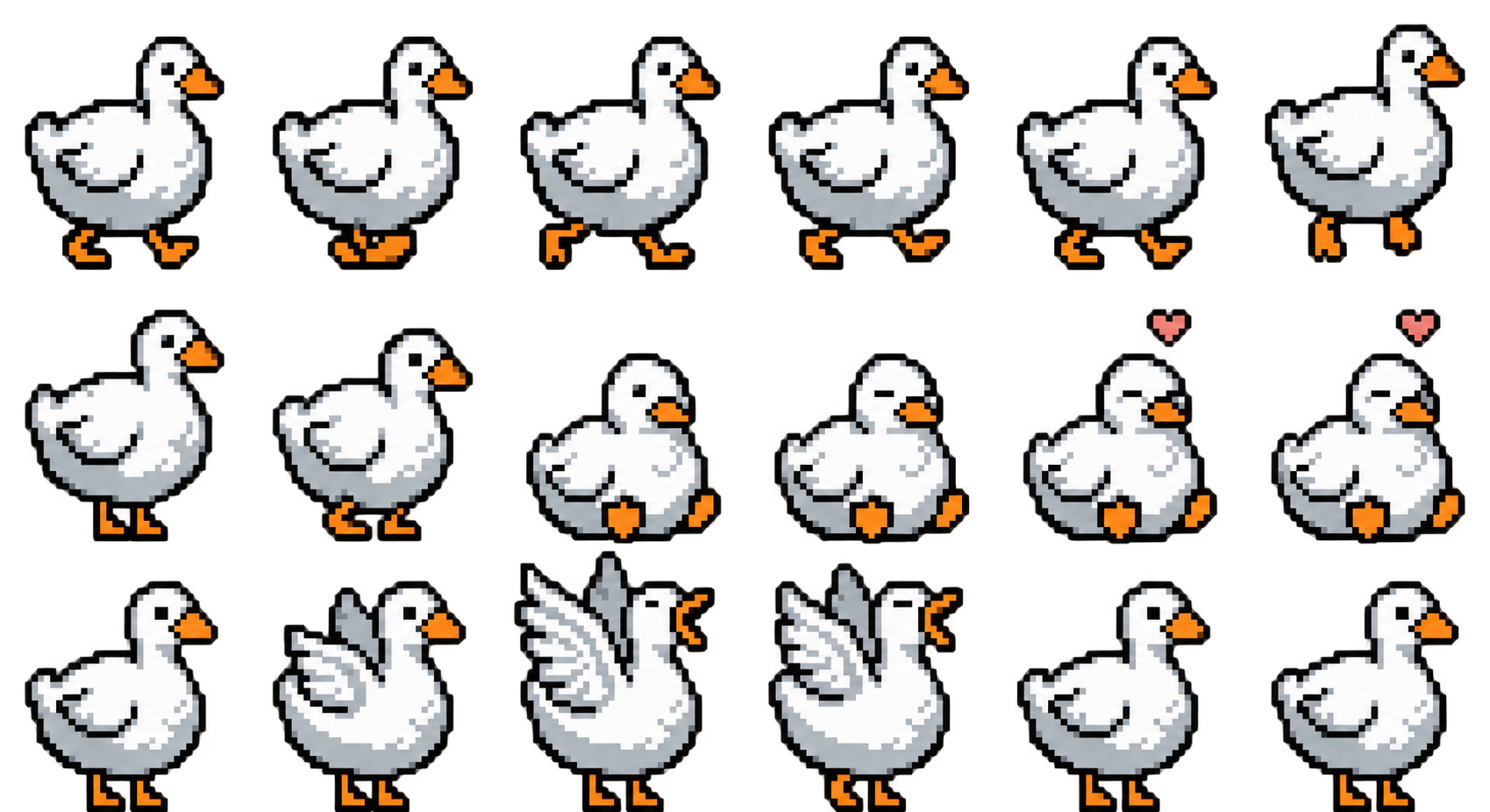
The current goose replaced the ASCII system on January 26, 2026. It uses a compact sprite sheet, a small state machine, and runtime mirroring to cover both leftward and rightward motion.
Mechanism
- The current goose is a single DOM node with
background-image: url(/goose-sprite-warm-heart.png)and a movingbackground-position. - The transparent sheet is displayed at
264×144, organized as a6×3grid of44×48cells. The sprite element itself is44×48, trimmed inside a40×46viewport. - Leftward movement does not use separate art. The same frames are mirrored at runtime with
transform: scaleX(-1)on the sprite element. - A
requestAnimationFrameloop advances both motion and animation state, while timers determine when to switch between walking, idle, sitting, and honking.
Behavioral Algorithm
- Walking: the goose drifts horizontally, cycles an eight-step walk playback, and bounces at the left and right bounds.
- Idle: the goose stays in place and alternates between two row-three standing frames before returning to walking.
- Sitting: it plays a sit-down transition, loops through the seated heart frames for 5 to 15 seconds, then plays a get-up transition.
- Honking: it runs an eight-step wing-flap cycle, then idles briefly before randomizing direction and returning to walking.
- Interaction: clicking the live goose forces the state machine into `honking` immediately if it is not already there.
Sprite Sheet
The live sheet is the same asset used in the current site header. The atlas below shows every raw frame the state machine references.
Walk Row
Playback order while walking: (4,0) → (3,0) → (2,0) → (1,0) → (0,0) → (1,0) → (2,0) → (3,0).
Deepest forward stride
Return from stride
Mid-waddle
Pre-stride
Neutral walk anchor
Sit / Heart Row
Sit-down uses (1,1) → (2,1), seated loop uses (3,1) → (4,1) → (5,1) → (4,1), and get-up uses (2,1) → (1,1) → (0,1).
Final get-up frame
First sit-down frame / second get-up frame
Second sit-down frame / first get-up frame
Seated neutral frame
Heart loop frame A
Heart loop frame B
Honk / Idle Row
Honk playback: (0,2) → (1,2) → (2,2) → (3,2) → (3,2) → (2,2) → (1,2) → (0,2). Idle playback toggles (4,2) and (5,2).
Honk frame 1
Honk frame 2
Honk frame 3
Honk frame 4 / peak flap
Idle frame 1
Idle frame 2
Directional Note
The sprite atlas itself only stores one facing direction. Leftward travel is produced by flipping the sprite element with CSS. That means the walk, idle, sitting, and honk sequences all reuse the same raw cells regardless of direction.