Kayfabe at Work
How organizations learn to mistake the performance of competence for competence itself.
A team needs a decision. Twelve people join a call.
Someone presents the options. A director asks whether the relevant stakeholders have been consulted. Another points out that the decision overlaps with an initiative in their organization. Someone suggests a framework for evaluating the dependencies. The framework needs an owner. The owner will need input from the stakeholders.
By the end of the meeting, everyone has made a recognizable contribution. The original question remains unresolved. Another meeting has been scheduled.
Nobody has said anything obviously foolish. Consultation, ownership, and understanding dependencies can all matter. Each intervention is defensible in isolation. Yet the collective result is an elaborate suspension of activity, accomplished by people who may sincerely believe they have moved it forward.
Imagine placing a recording of this meeting in a gallery:
Alignment
Twelve participants, one presentation, an unresolved question.
Duration: recurring.
The recording would require very little editing.
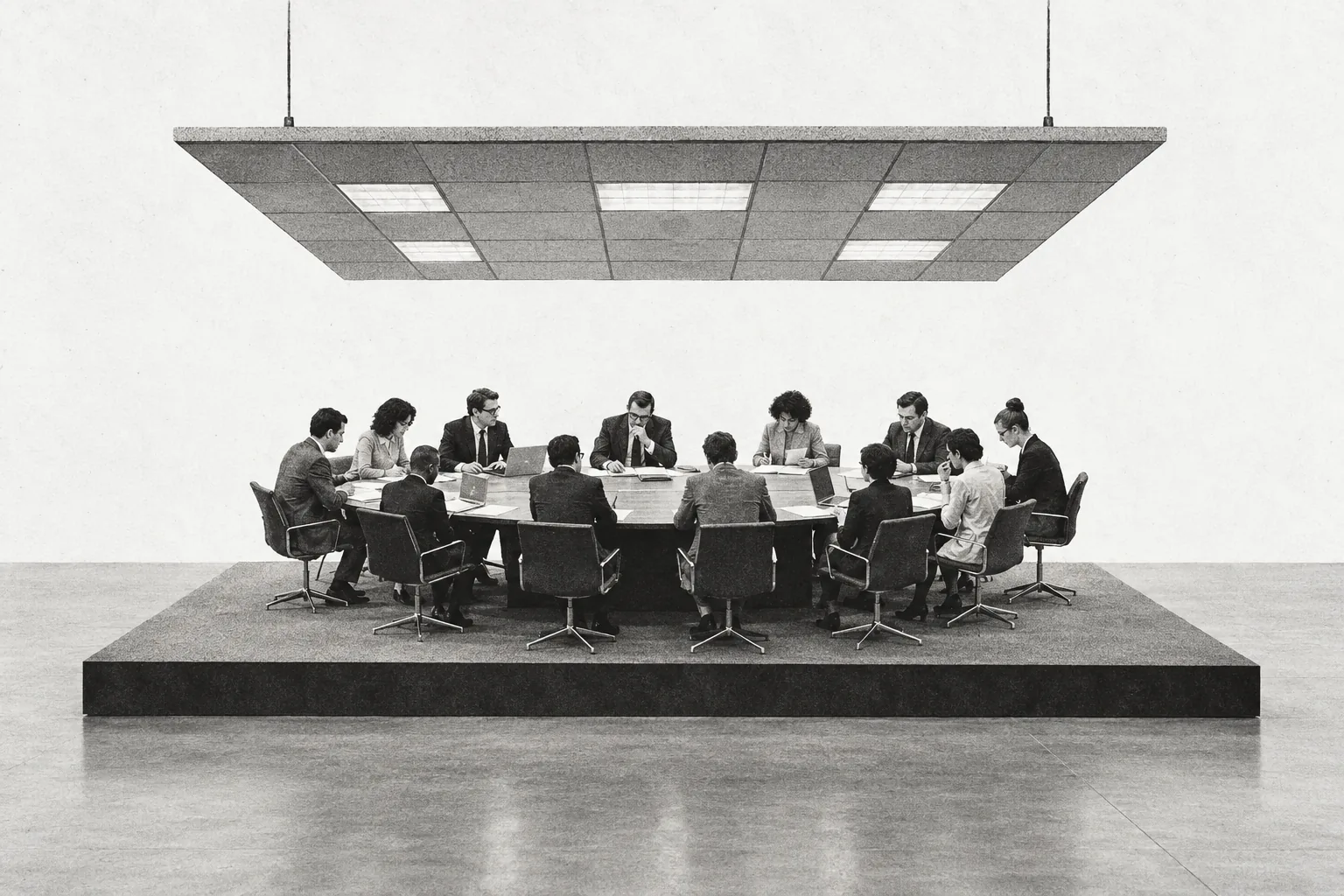
Dada used nonsense, incongruity, and deliberate provocation to challenge established culture and its claims to reason. Its absurdity was intentional. The artists understood that they were making something disruptive. The office can arrive at a comparable spectacle through earnest attempts to maintain order. Everyone follows the conventions of sensible professional behavior, and the result becomes absurd. Dada
The art appears when someone puts a frame around it. The institution has already supplied the material.
But the Dada analogy only gets us partway there. It captures how the activity looks from outside. Kayfabe helps explain how it can remain convincing from within.
In professional wrestling, kayfabe maintains the reality of staged characters, rivalries, and events. The performance works through a convention about what participants present as real. Cambridge Dictionary
An office has a more complicated relationship with its own performance. There may be no reliable backstage where everybody agrees which parts are theatre.
One person knows the presentation is mostly positioning. Another sincerely believes it is a necessary strategic artifact. A third thinks the whole exercise is ridiculous but assumes that someone further up the hierarchy needs it. The executive receiving it assumes the process of preparing it helped the teams coordinate.
The apparent necessity can circulate without anyone being able to locate its source.
In his essay on kayfabe, Eric Weinstein proposes the concept as a way to understand institutions in which layers of staged reality become difficult to disentangle. The office version is especially interesting because the performance can be inherited. People learn it as the ordinary practice of their profession. Weinstein, “Kayfabe”
A new employee watches successful colleagues. They learn which documents matter, how to demonstrate ownership, when to request alignment, and how to make their contribution visible. They acquire these habits through perfectly ordinary efforts to become competent.
Eventually, they are promoted for doing them well. Then they teach them to someone else.
No conscious decision to deceive anyone is necessary.
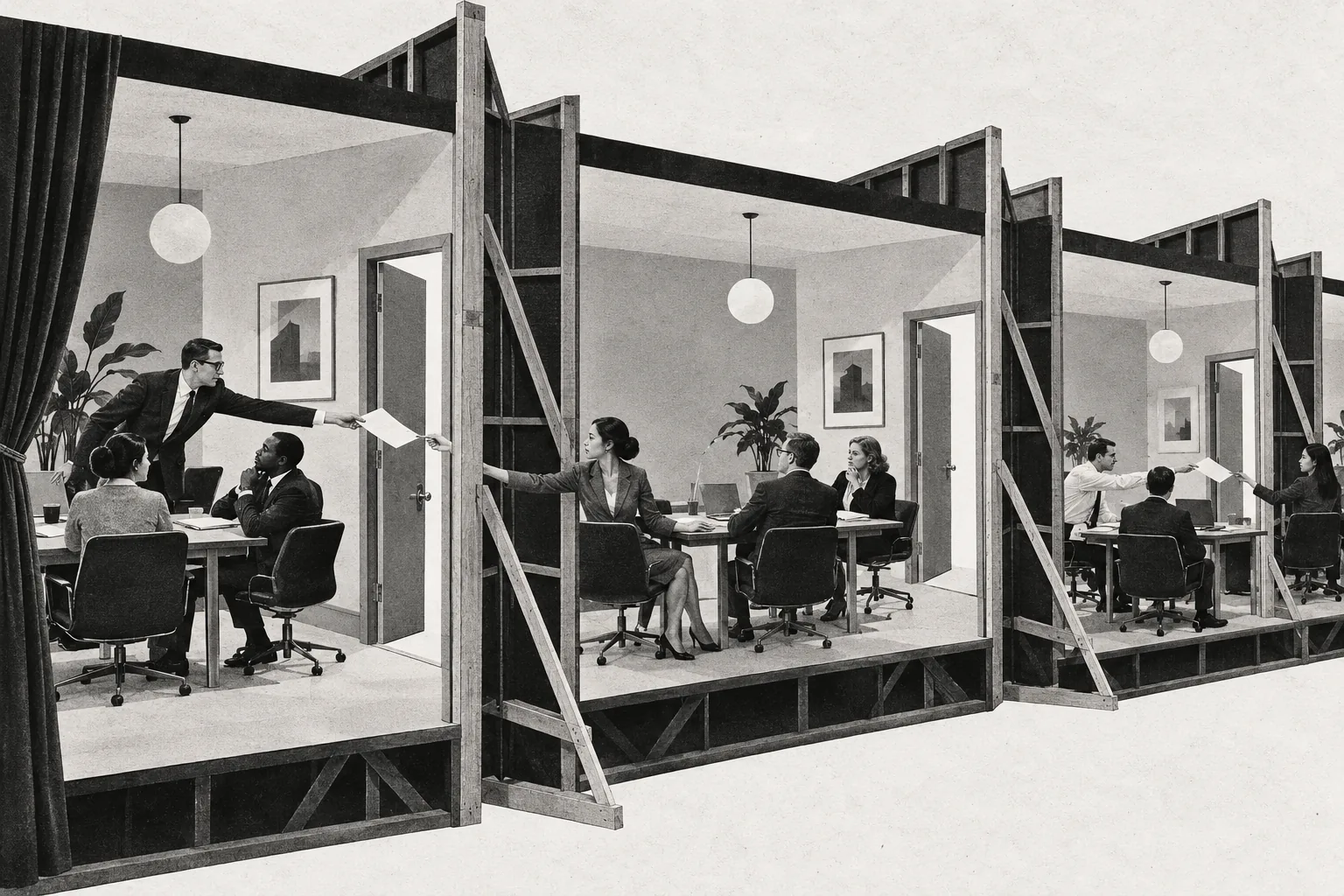
The process may even begin with a useful practice. A review catches a serious mistake. A planning document helps several teams coordinate. A meeting resolves a dispute that had blocked progress.
Over time, the visible form becomes easier to recognize than the benefit it was intended to produce. The existence of a review becomes evidence of diligence. A completed planning document becomes evidence of strategic clarity. Attendance by senior people becomes evidence that a decision has received appropriate attention.
These are convenient proxies. They are also available for inspection in a way that judgment, understanding, and avoided mistakes often are not.
Careers can then develop around producing the proxies. The person who knows how to get a proposal through the process becomes indispensable to the process. Their success reinforces the belief that the process requires their expertise.
Meyer and Rowan described a related problem in their work on organizational “myth and ceremony”: formal structures can gain legitimacy and persist while becoming detached from the activities they supposedly coordinate. A practice can help an organization look properly constituted even when its operational contribution is uncertain. Meyer and Rowan, 1977
Inside such a system, awareness is often uneven. People can recognize individual performances without questioning the structure that makes performing necessary.
“Obviously this steering committee is political,” someone says. “But navigating it is what leadership means.”
That observation might be accurate. Navigating the committee may genuinely be necessary to get anything done. The unresolved question is why the organization needs the committee in its current form, and whether maintaining the obstacle should continue to confer authority on the people most adept at overcoming it.
Cynicism offers no automatic escape. Knowing how the game works can become another professional credential.
The stakes make the situation harder to see clearly. People really do work late on these presentations. They experience anxiety before reviews. They earn promotions, lose influence, build friendships, and pay their mortgages through the institution.
Those consequences are real. They can make the institution’s explanation of them feel equally real.
Someone who earns a promotion after managing a complicated approval process has good evidence that the organization values that ability. It is much harder to determine whether the process contributed enough to justify the effort spent managing it. The promotion does not answer that question.
Our essay on elite overproduction and AI disruption examines what happens when the number of people expecting seniority grows faster than the scope available for exercising it. One plausible consequence is increasing demand for occasions on which seniority can be demonstrated.
Reviews, approvals, and ownership negotiations provide those occasions. A decision acquires more participants, each with a legitimate expectation of involvement. Consultation becomes a way to acknowledge standing. Removing a step can therefore threaten someone’s position even when the decision itself is straightforward.
Two directors can sincerely fight over ownership of a project while sharing the premise that it requires their level of involvement. The rivalry is real. So is their common investment in the structure that gives the rivalry significance.
This is where the limits of the wrestling analogy become useful. Corporate competition is rarely scripted, and its outcomes can be deeply consequential. What participants may jointly sustain is a story about why their competition is necessary to the work.
That story becomes visible when someone steps outside it.
Imagine a small team returning with a working version of something the organization is still preparing to discuss. It solves a recognizable problem. Someone has used it. There is evidence to examine.
The response might be curiosity. It might also be alarm.
Who authorized this? Which organization owns it? Why were the stakeholders not involved? How does it fit the roadmap?
Any of those questions could identify a real problem. A working prototype does not settle questions of reliability, security, support, or responsibility. But the questions can also serve to restore the familiar order of participation. The organization may struggle to distinguish a missing safeguard from a missing ceremony.
“Involvement” can mean several different things. Someone may hold knowledge that will change the design. Someone may need to learn enough to maintain the result. Someone may carry responsibility for a risk. Each gives participation a purpose that can be examined.
The difficulty begins when involvement becomes a requirement without a corresponding contribution or commitment. The person moving the work must discover who belongs, arrange their participation, interpret their concerns, and account for their absence. Progress becomes conditional on a process whose demands have no clear end.
The organization can sincerely value initiative while making initiative responsible for every difficulty it encounters. The people asked to deliver must also reconcile competing expectations about pace, participation, and ownership, often without the authority to choose between them. Eventually, waiting becomes the more defensible professional choice.
The cost is more than a delayed result. People learn which forms of initiative are welcome, and which create trouble. They can become very good at anticipating the process before they have tested whether the work is useful.
Someone who bypasses the expected performance can consequently appear inexperienced or irresponsible, even when they have produced useful work. Their result challenges the organization’s ability to recognize competence.
AI makes this tension more interesting because it can change the cost of producing something concrete enough to evaluate. A small team may be able to test an idea before the institution has completed the process that ordinarily precedes testing.
That creates an opportunity to compare the process with an alternative. It does not guarantee that the organization will welcome the comparison.
AI can also make the performance much more elaborate.
Presentations, proposals, status reports, meeting summaries, and strategic frameworks become cheaper to produce. An organization can generate more evidence of activity without improving its understanding of the problem. One system writes the pre-read. Another summarizes it. People meet to establish that they have engaged with the summary.
The cost of producing each artifact falls. The institution may respond by requiring more artifacts.
A company can automate the production of evidence that it is working.
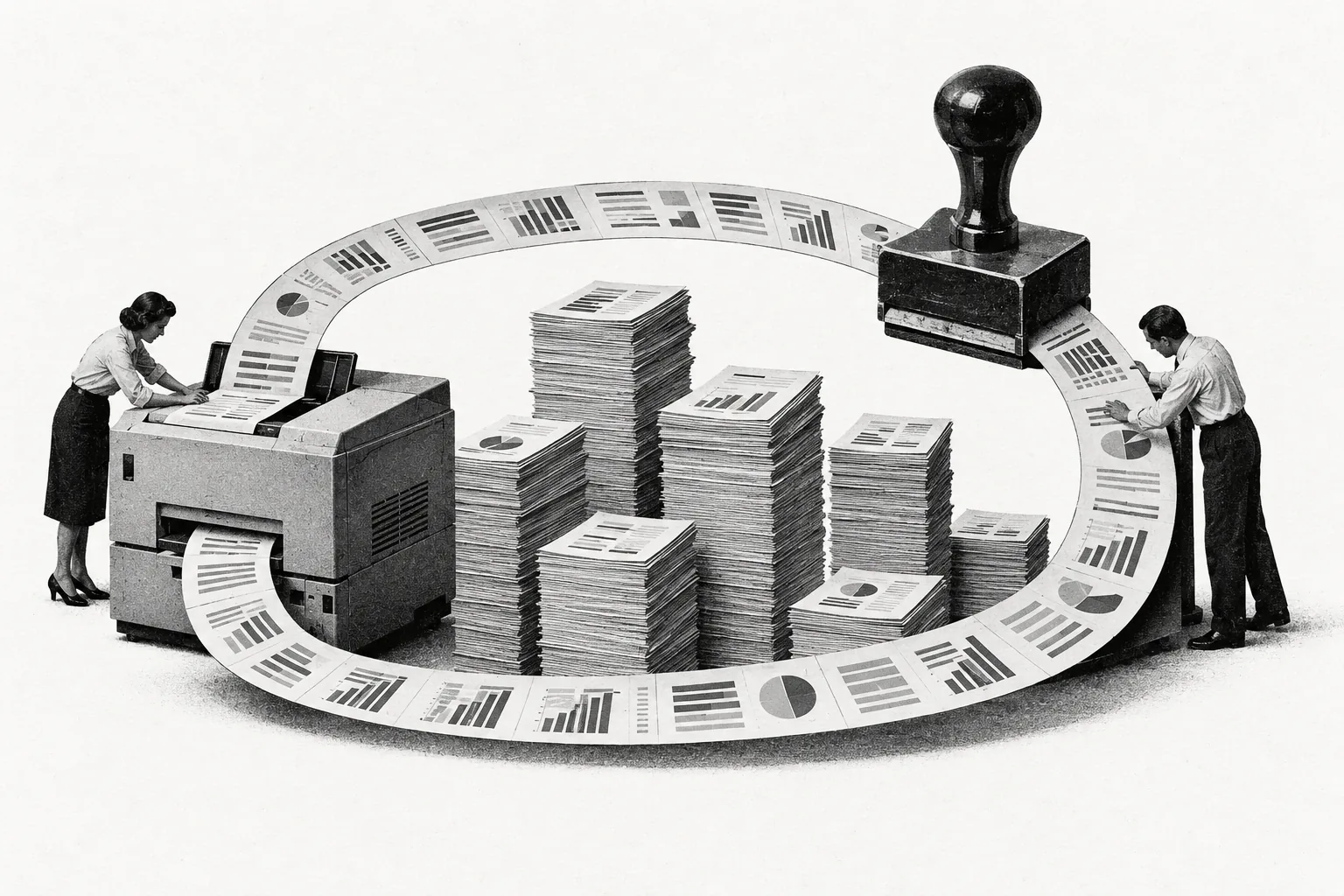
Builders should be particularly careful about treating this as someone else’s problem. Engineering and AI teams have their own recognizable performances of competence: impressive demonstrations, elaborate architectures, shipping velocity, agent counts, and dashboards full of completed tasks.
A demonstration can establish that something is possible while leaving its usefulness largely untested. A high rate of output can conceal rework. A sophisticated system can make its creators look capable while making its users’ lives more difficult.
The identity of “the person who actually builds things” can become its own protection against scrutiny. Feeling closer to the work does not exempt anyone from showing what the work accomplishes.
An open repository and an invitation to contribute can become another convenient proxy. They establish that the work is available; they do not establish that another person understands it, can change it, or can take responsibility for it. Teaching, translating, and working through a real example together may be the most useful work still to do. Builders have to examine their own preferred signs of collaboration with the same care they bring to everyone else’s.
The practical response begins with reconnecting activity to consequences.
For a recurring meeting, that might mean identifying the decisions it enables and checking whether they happen. For a review, it means understanding the risks it catches and whether its current form is proportionate to them. For an AI capability, it means observing whether someone uses it successfully, what corrections it requires, and whether it improves the task enough to justify maintaining it.
Some rituals will earn their place. They help people trust one another, preserve institutional memory, and make commitments visible. Their value deserves examination alongside their cost.
The revealing test is whether the organization can recognize when a practice has stopped earning its place.
What evidence would justify removing it? Can the person responsible for it propose its retirement without threatening their career? Can someone receive recognition for making their own involvement unnecessary?
Those questions reach deeper than a campaign to reduce meetings. They examine whether an organization can revise its understanding of competence when the work changes.
This is why small useful capabilities and observable work matter. They create opportunities for contact with consequences: someone tries the thing, encounters its limitations, and supplies evidence that can change what happens next. A persuasive account of progress has to meet an experience outside the account.
That standard applies to Goose Group’s own arguments about small teams and AI. They should produce useful results that can be examined. Otherwise, they risk becoming another professional vocabulary through which a group recognizes and congratulates itself.
The meeting at the beginning might be necessary. Twelve people might be exactly the right twelve people. The unresolved question might deserve another hour.
A healthy organization should be able to explain why—and learn when the explanation no longer holds.
Can your organization recognize useful work when it arrives without the expected performance?
Original editorial illustrations generated with AI for this essay.