Elite Overproduction at Work
A company can create more people entitled to be involved than useful things for them to do. The result is a curious form of growth: decisions acquire participants faster than they acquire information.
Everyone has scope. Everyone has stakeholders. Everyone needs to demonstrate that their level was justified. A problem that might once have required two people now needs an alignment meeting, because six other people’s importance has become attached to its resolution.
AI makes this arrangement more conspicuous. When the people close to a problem can make something useful before the organization has finished negotiating who gets to discuss it, the delay becomes harder to explain.
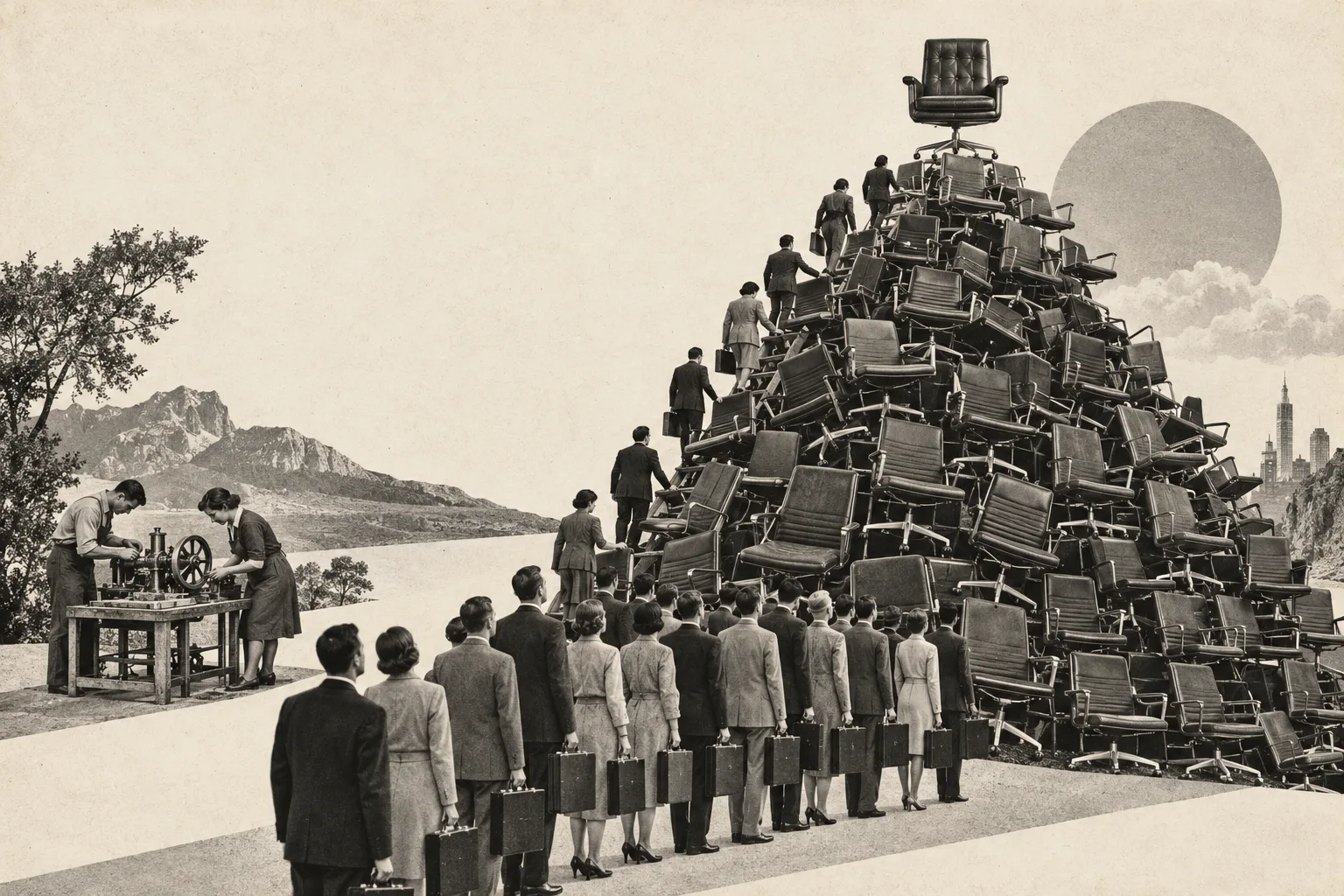
Promotion creates expectations the work may not satisfy
Peter Turchin uses elite overproduction to describe an expansion in the number of people aspiring to positions of power relative to the positions available. In his account, competition among elites can consume the cooperation that previously held a society together. His argument concerns historical societies; applying it inside a company is an analogy we are proposing, not a finding of his research. Turchin on intra-elite competition.
The corporate version begins with a familiar bargain. Do well, get promoted, gain influence. As a company grows, it can keep that bargain by creating more territory: new products, teams, markets and decisions. When growth slows, the expectations remain. So do the people who have organized their lives around meeting them.
If seniority is demonstrated through headcount, budget and participation in important decisions, people will seek those things. The competition need not be malicious. A director who does not defend their scope may be judged less capable than one who does. A manager who makes their involvement unnecessary may have a harder promotion story than one whose approval is required everywhere.
Under those conditions, reducing coordination has a constituency against it. Removing a meeting can remove someone’s most visible evidence that they matter.
The approval chain becomes part of the product
Consider what happens when two teams need to make one decision. Each can bring useful knowledge, carry a real risk or make a commitment the other depends on. Their conversation has a job to do.
Now add an obligation to acknowledge every relevant level of the hierarchy. The person trying to move the work must identify the people who expect involvement, find out what would satisfy them, prepare the appropriate version of the account, and keep everyone informed without allowing any one account to contradict another.
This can become an exacting professional skill. It also gives the organization a new dependency: the work cannot move without someone who knows how to move it through the organization.
The dependency helps justify the structure that produced it. A person becomes indispensable by navigating an obstacle everyone has stopped asking whether they need.
This is why “just reduce the meetings” rarely reaches the problem. A meeting may be carrying recognition, protection from blame, an unresolved authority dispute or a genuine need to understand. Deleting the invitation does not settle any of those. Someone has to make a different arrangement possible.
AI changes what can happen before permission
Some kinds of software are now cheap enough to try without assembling a project around them. A person can describe a recurring frustration, work with an AI assistant or a colleague who builds, and return with something concrete enough to evaluate.
That changes the conversation. The question can become whether the thing helps, what it gets wrong and what would make it easier to use. The work supplies material for judgment that a proposal could only anticipate.
It also creates a status problem. The person who was supposed to sponsor the initiative may encounter it after it exists. The team assigned to discover the requirements may discover a working version instead. People whose roles assumed they would mediate between a need and its solution have to find a useful contribution under different conditions.
They may have one. Connecting the work to another team, teaching someone how to maintain it, solving an access problem, making a consequential decision or taking responsibility for an operating service can all matter enormously. Those contributions become clearer when they are attached to something real.
But “keep me in the loop” cannot remain a complete description of the job. The loop is becoming cheaper to see. Participation has to bring something to it.
Small teams gain room to act
A small team with shared judgment can spend less of its time translating the work into claims on a hierarchy. People can understand a problem, make choices and try something together. If the first version is wrong, there are fewer positions invested in defending it.
That is an opportunity, not a law of organizational size. A three-person company can revolve around a founder’s ego. A large organization can give a cohesive team room to work, access to people who know the subject, and resources it could never assemble alone. Size tells us less than the distance between the people doing the work and the people who can decide what happens next.
Nor does cheaper software remove every other advantage. Customers still need to find and trust a service. Systems still need to work together. Knowledge, relationships and the ability to support something over time matter. A small team has to make something useful enough to justify attention; being less annoying than a steering committee is a low bar.
The advantage worth protecting is the ability to contribute without first building a structure to authorize the contribution.
The hierarchy can change what it rewards
An organization that wants initiative has to make room for it in more than its values deck. Someone should be able to solve a problem without first surrendering it to the appropriate layer. A manager should be able to gain standing by helping others act, including when the result makes the manager less necessary.
That asks for real decisions. Who can make this call? Whose knowledge would change it? What responsibility comes with the choice? What does the person asking for involvement intend to do? A clear answer can remove several rounds of alignment without removing anyone’s ability to contribute.
It also asks leaders to accept awkward truths. Sometimes a process exists because somebody important once wanted it. Sometimes an initiative is failing and the people writing its updates know that. Sometimes the expert hired to advise the company has learned that the company needs less of the expert.
We value independence partly because it makes those conversations easier to have. We do not need a place in someone else’s promotion ladder. We can bring a view, help with the work and leave when our contribution has run its course. That freedom is useful only if we use it honestly, including when the awkward truth is about our own work.
Builders have their own aristocracy
“The people who actually build things” can become another status claim. It can excuse poor explanation, indifference to maintenance, or contempt for the people who have to live with the result. An impressive demonstration can be as ceremonial as a strategy deck.
Our Kayfabe at Work essay applies the same question to both: what did the performance allow someone to accomplish? Shipping is evidence that something was made. Use, correction and contribution tell us more about what it was worth.
AI creates an opening for useful work to travel through fewer intermediaries. What follows depends on whether organizations can recognize contribution when it arrives without the expected title, and whether the people making it can resist turning their own success into another reason everyone must come through them.