The Happy Mascot Problem
A chicken shop with a cheerful chicken mascot is a small, perfect contradiction. The chicken gives a thumbs-up for chicken. The subject of the system has become the system’s spokesperson.
Office life has its own versions. A culture deck describes the organization as a place for bold ideas while a useful change waits for its fourth approval. A values campaign celebrates candour while people learn which subjects must be discussed privately. The people carrying the contradiction are invited to appear in the photograph that proves it does not exist.
The mascot is doing more than making the shop look friendly. Its happiness supplies an endorsement from precisely the party whose opinion might otherwise complicate the transaction.
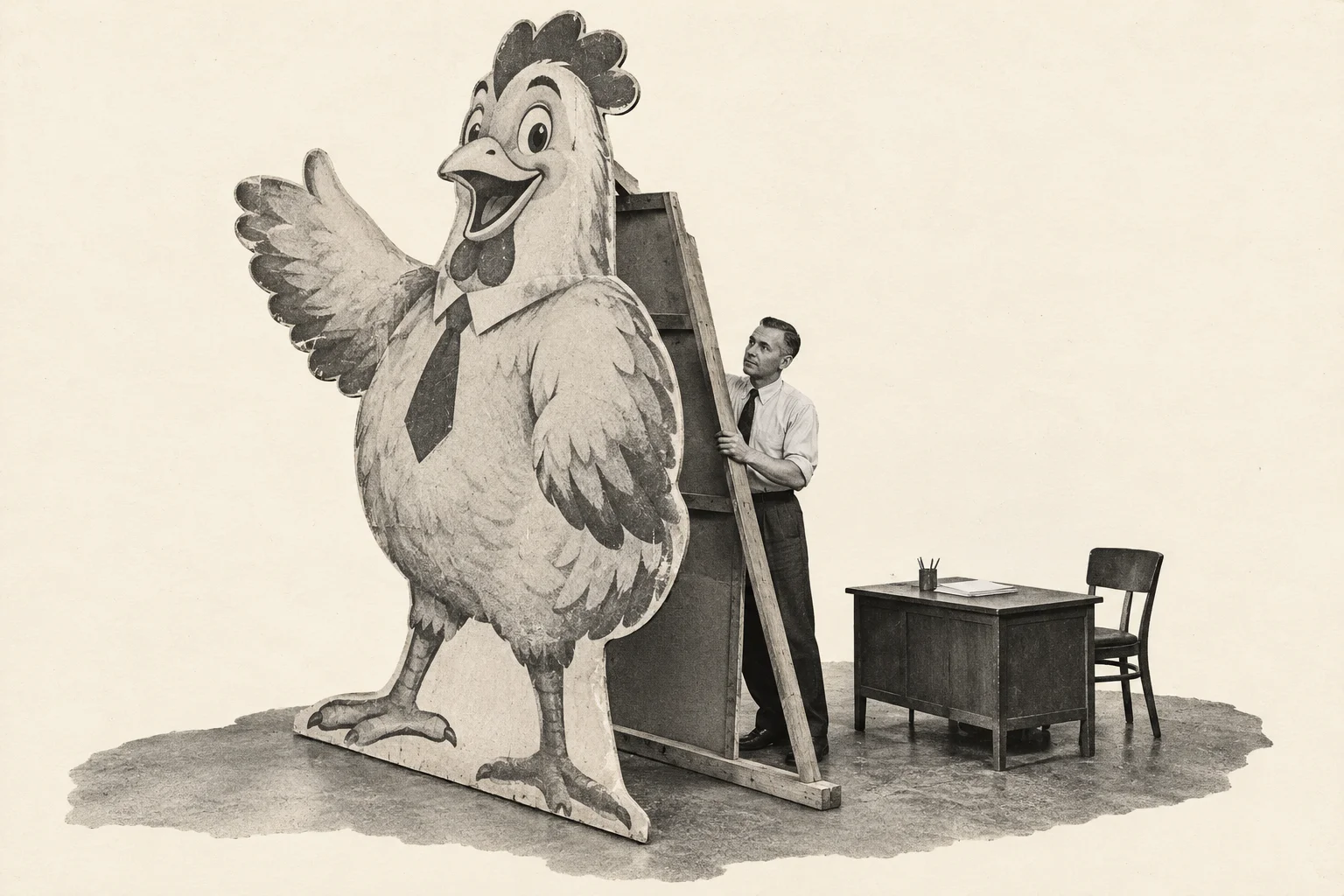
The smile can become part of the job
An organization does not need everyone to believe its story. It can get by with people behaving as though they do.
The meeting happened, so the team was aligned. The initiative has enthusiastic advocates, so its effects must be welcome. Everyone contributed a cheerful paragraph to the update, so there cannot be a serious problem. The representation of agreement becomes easier to recognize than the work of reaching one.
A person who objects can then find that the objection itself becomes the problem. Their concern may be accurate, but the discussion moves to their attitude, their communication style, or their failure to bring everyone along. They are asked to repair the mood around a fact nobody wants to address.
This can make enthusiasm into an additional duty. Doing the work is no longer enough; the person must also demonstrate that the arrangement is good for them. The chicken has to write its own testimonial.
Enjoyment is allowed to be real
People like their colleagues. They enjoy a shared joke, take pride in something they made together, and find comfort in belonging. A meal, a party, or an affectionate company ritual can be valuable without producing a single business result.
It would be a miserable reading of working life to treat all of that as evidence of manipulation. People make warmth inside imperfect arrangements, and the warmth can be entirely theirs. They do not need to abandon it to prove that they understand the arrangement’s faults.
The distinction appears when enjoyment is used to close an argument. Liking the people does not settle whether the workload is reasonable. Having fun at the party does not establish that the promotion system is fair. A shared purpose does not make every instruction issued in its name sensible.
Real warmth leaves room for those differences. People can enjoy the company and still criticize a decision, decline an invitation, or want some part of it to change. Belonging becomes something else when it requires a continuing performance of gratitude.
People may already see the menu
Naming the contradiction can make it easier to discuss. The mascot still smiles, but now you can see the menu.
The difficulty is that many people already can. They know the meeting will change nothing, but declining it would be noticed. They know the update is fiction, but an honest one would make them responsible for the problem. Their participation may be a sensible response to the consequences of refusing.
Knowing laughter can even help the performance continue. Everyone gets a moment of recognition, then goes back to preparing the deck. A joke has relieved the pressure without changing what produces it.
That does not make the joke worthless. It can give people a shared way to describe something they had been experiencing alone. But the person who names the absurdity has not thereby made it possible for somebody else to stop performing it.
AI can supply a larger props department
AI makes it easier to produce the material around work: summaries, updates, plans, reassuring explanations, and persuasive accounts of progress. Used without judgment, it can make an organization much better at representing activity while leaving the useful decisions unanswered.
The person who once spent Friday writing a status report can now generate it quickly. That may be a welcome improvement. If the response is to ask for five more reports, the person has gained a more capable reporting machine and very little freedom.
AI also makes another arrangement possible. Someone who understands a problem can make a first version, examine it with a colleague, and change it. Their contribution can arrive before the hierarchy has finished deciding who should be involved. A structure whose main contribution is making them ask three times becomes harder to defend.
The question is what happens to the room that creates. People might spend more time with customers, follow an unexpected idea, or learn something that changes what they want to attempt next. Ability Is Not Obligation argues for protecting that space. Making the machinery faster should give the people around it more possibilities.
Change what the performance is protecting
A useful response gives people somewhere else to put the need behind the ritual. A meeting may be carrying a real wish to understand the work, an unresolved decision, or a fear of being blamed. Those needs deserve attention. Another polished account of agreement will not necessarily meet them.
A leader can take responsibility for the choice that keeps circulating. A working conversation can replace a presentation nobody uses. Someone can stop asking for cheerful updates and help with the difficulty those updates conceal. These changes make honesty more useful and less costly to the person offering it.
Independence gives us room to say what we see and to decline a bad arrangement. A customer’s employee may not have the same freedom. We should use ours to carry the argument, explain a workable alternative, and take responsibility for our advice. Calling the ritual ridiculous and leaving someone else to deal with the consequences would be a fairly modest contribution.
We have a cheerful goose on the website. Our own methods need the same examination. Building quickly, using agents, and publishing clever criticism can all become performances. The fact that we enjoy them does not establish that they help the people working with us.
Give the happiness something to be about
The desire underneath the story is worth taking seriously: work with dignity, people who know why they matter, authority that carries responsibility, and enough trust to try something together. The failure of a company to provide those things does not make wanting them foolish.
We want to build a company where useful work, jokes, curiosity, and care can share the day. People should be able to take pleasure in what they do without that pleasure being recruited as proof that everything is fine. A good joke can remain a good joke. A generous gesture can remain generous.
The chicken-shop image works because the endorsement is so obviously convenient for the shop. The human version deserves the same attention: who gets to say whether the arrangement is good, and what happens when their answer changes?
Original illustration generated with AI for this essay.