Friction Should Earn Its Place
Most friction in working life does not need a philosophical defence. A file is hard to find. Someone has to enter the same information twice. A person with a useful idea is waiting for a meeting whose participants cannot authorize it. Removing those obstacles is usually a straightforward improvement.
But some activities become less valuable when we make them effortless. Working through a difficult question can change what we understand. Explaining a choice to another person can expose a mistake. Learning to do something ourselves can be worth more than receiving an excellent version made by someone else.
AI makes this distinction harder to avoid because it can produce the artifact while bypassing much of the activity that used to produce it. We can have the answer-shaped object before we have done the thinking it appears to represent.
The task is to understand which effort matters, then design around that. Friction should have to explain itself.
Some of the value is in doing the work
Writing a recommendation forces choices. What is the actual problem? Which evidence matters? What do we think should happen, and what would make us reconsider? The final document carries the conclusion, but making it can be how its author reaches one.
An assistant can help with that work. It can find relevant material, challenge a weak argument, compare alternatives and make a draft easier to read. It can also let the author skip directly to a polished position they have never examined.
Keeping the useful effort does not mean making someone type every sentence unaided. It means preserving their encounter with the decision. Ask them to explain the choice, inspect a troublesome example or defend the part the assistant made sound obvious. The difficulty belongs to understanding the work, not to manually performing every step around it.
The same applies to learning a tool. Doing the first task together may take longer than having the experienced person finish it. That time can leave someone able to do the next task themselves. Repeatedly doing it for them can be fast in a way that never gets faster for anyone else.
Care sometimes asks us to stay
A conversation may appear inefficient because its visible output is small. Two people spend half an hour and change one sentence. The sentence may have been the easy part. They were also discovering what the other meant, repairing a misunderstanding or becoming willing to disagree honestly.
That does not justify every recurring call. It tells us to examine what the interaction does before replacing it with a summary. If the value is a decision, help people decide. If the value is learning together, give them something real to learn from. If nobody can identify what the interaction gives them, its duration is not evidence of depth.
Care is also attention to the person who bears the burden. An organization may enjoy the reassurance of an extra review while making someone else wait for help. The review needs to be worth that cost to the service, not merely comforting to the reviewer.
It is possible to be very diligent about making another person’s life more difficult.
Consent needs a choice someone can understand
Sometimes we should interrupt an otherwise smooth action. A person may need to notice that they are sending something, sharing information or making a commitment. A deliberate pause can give them a chance to understand and choose.
The pause earns its place through that choice. A vague warning, another compulsory acknowledgement or a long form nobody can reasonably interpret may produce evidence that a person clicked without helping them decide anything.
Good design makes the consequence understandable and the alternative real. It should be possible to decline, change course or ask a question. The goal is the person’s agency; adding a checkbox is only one possible implementation, and often an inadequate one.
We should also be willing to remove friction from the opposite direction. If joining is effortless but leaving requires a telephone negotiation, the system has made its priorities clear.
Review should change what happens
A second person can catch what the first missed. They may know the customer, understand the consequences or recognize an exception the author has never encountered. Their review has a contribution to make.
An approval chain can look similar while doing very different work. Each participant confirms that the previous participant was involved. Responsibility is distributed so thoroughly that nobody feels able to exercise it. The delay is real; the judgment is difficult to locate.
The useful question is what this person can add at this point. If their knowledge is needed earlier, involve them earlier. If the task has become routine enough that they rarely change anything, reconsider the arrangement. If the consequence is significant and hard to reverse, an attentive review may be an excellent use of everyone’s time.
There is no universal number of approvals that makes work thoughtful. The design has to follow the consequence, the available knowledge and the people doing the work.
Useful friction can expire
A step introduced while a team is learning may become unnecessary once they understand the work. A careful explanation for a new colleague can become an irritating requirement for someone who now teaches others. A temporary review can survive long after anyone remembers what prompted it.
Regular reconsideration does not need its own committee. When a step repeatedly causes delay, when people stop learning from it or when the work changes, ask what it still contributes. The people carrying it should be able to answer honestly, including by saying that it no longer helps.
That permission matters. Otherwise, every obstacle can find a respectable word to hide behind: care, quality, collaboration, governance. The words describe possible purposes. They do not demonstrate that the current arrangement serves them.
The same scrutiny belongs to a new AI tool. It may remove tedious work, or it may move effort onto the person who has to check its output. It may help someone learn, or make them dependent on an answer they cannot assess. Its speed is useful evidence about speed. We still need to see what it does to the job.
We should make ordinary work easier wherever we can. Where effort protects understanding, care or a meaningful choice, we should be able to say whose benefit it serves and why it belongs there. Then keep paying attention. Useful friction is something we choose for a purpose, and something we remain free to remove.
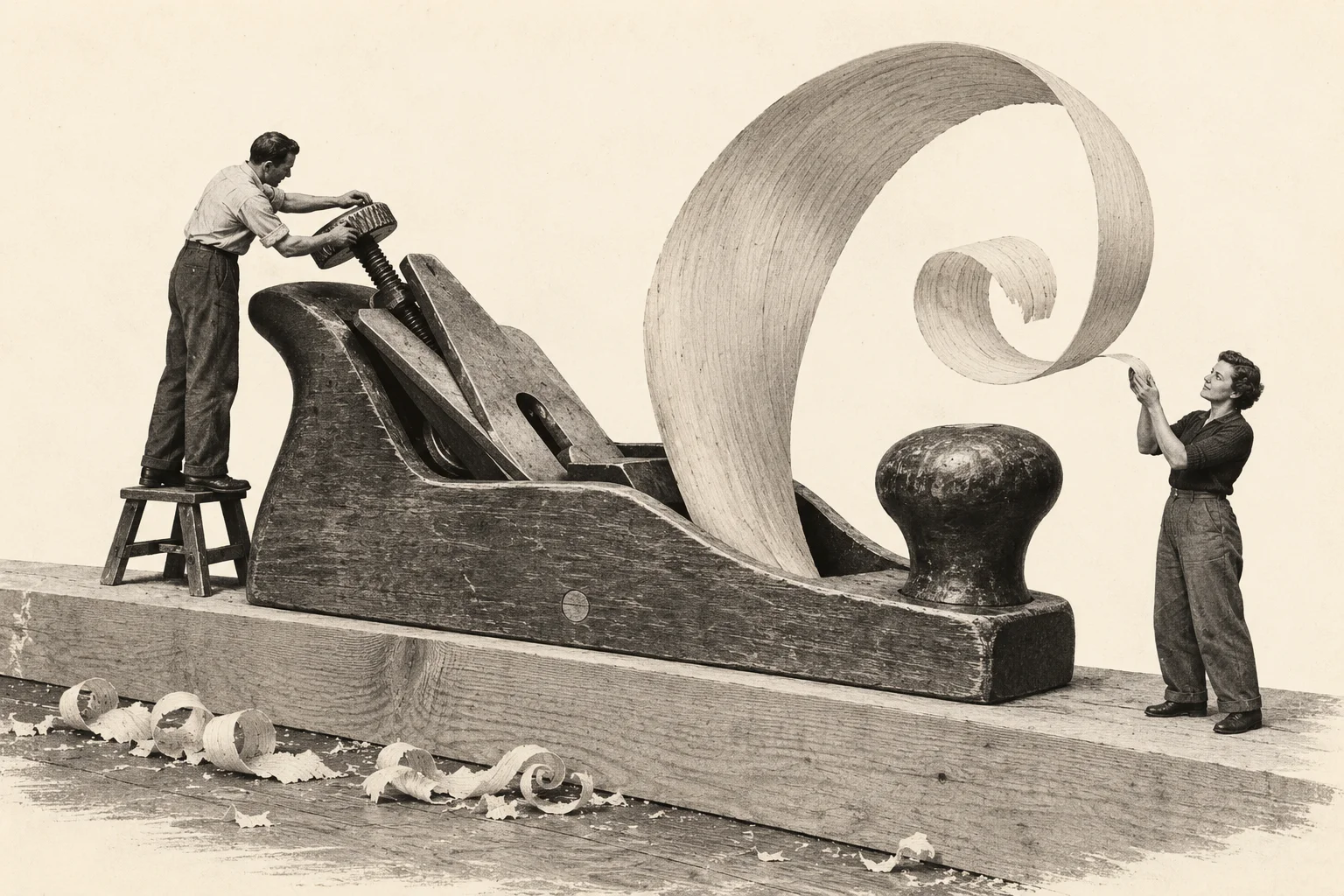
Original editorial illustration generated with AI for this essay.