Management in the Age of Mechanical Observation
AI can make the work visible. It cannot make it official.
Imagine a junior analyst spending an afternoon describing to an AI the tool she has wanted for a year. By the evening she has a version she can try. By Friday she has changed the process it was built to support.
Her manager had that tool on next quarter’s roadmap. He hears about it on Monday, from a summary his director forwarded to him. He asks to be kept in the loop. Could the team set up a weekly update, and find some time to align?
The work is available, although understanding it will still take attention. The request says a great deal about what he would like to receive, and nothing about what he would bring.
I. The bargain
In 1903 Frederick Winslow Taylor wrote: “All possible brain work should be removed from the shop and centred in the planning or laying-out department.” He made the proposed division explicit: managers would design the work and direct how it was done; workers would carry it out. The planning department had a claim on the imagining. Taylor, 1903
AI can push the other way. The analyst can help design the tool while making a version she can use. Wherever people have room to work like this, more of the planning and imagining can sit with the people who do the work, and with them more say over how it is done. Their work can also become visible to people beyond the immediate hierarchy, including the manager’s boss.
II. The ritual
A status update can do two jobs at once. It carries information upward, and it acknowledges who reports to whom. The second function can survive the first: everyone knows the position, but the appropriate people still need to be seen receiving it.
An accessible record can remove the need to carry the same facts around again. A conversation may still be useful for understanding them, making a decision or noticing what the record misses. But if none of those is happening, the acknowledgment may be the only job left. The request to be kept in the loop can arrive with no offer to contribute because receiving the update is itself part of the role.
Managers were trained and promoted inside this arrangement, and being informed was one way they learned that they mattered. Losing it can be a real loss. Treating that as personal vanity misses the bargain the organization made with them.
III. What is left
Slavoj Žižek noticed that knowing something is not the same as it being official: “it is not enough for all concerned individuals to know some fact; ‘it,’ the symbolic institution, must also know/‘register’ this fact.” Žižek, 1997
Every office has a project that everyone knows is dead and that is still on the roadmap. AI has made the work visible. It has not made it official. Someone still has to decide that this is now the plan, that the other project stops, that the risk is accepted, and that the work counted. Then they have to own it.
That is most of what good management always was, buried under the work of carrying information around. Mark Fisher defended “management as opposed to managerialism.” Managerialism asks to be informed. Management makes things official. Fisher, 2011
IV. Step one
Before asking to be kept in the loop, work out what you would add to it. Look at the work first. If it needs explanation, ask what you need to understand and spend the time understanding it. Then bring the decision, connection or commitment that helps it move.
Our own tools can automate the status ritual instead of retiring it: a weekly AI summary for every manager, read by nobody. The difference is not the tool. It is whether anyone decides anything with it.
The work has stopped waiting for the update. There is still a useful job to do.
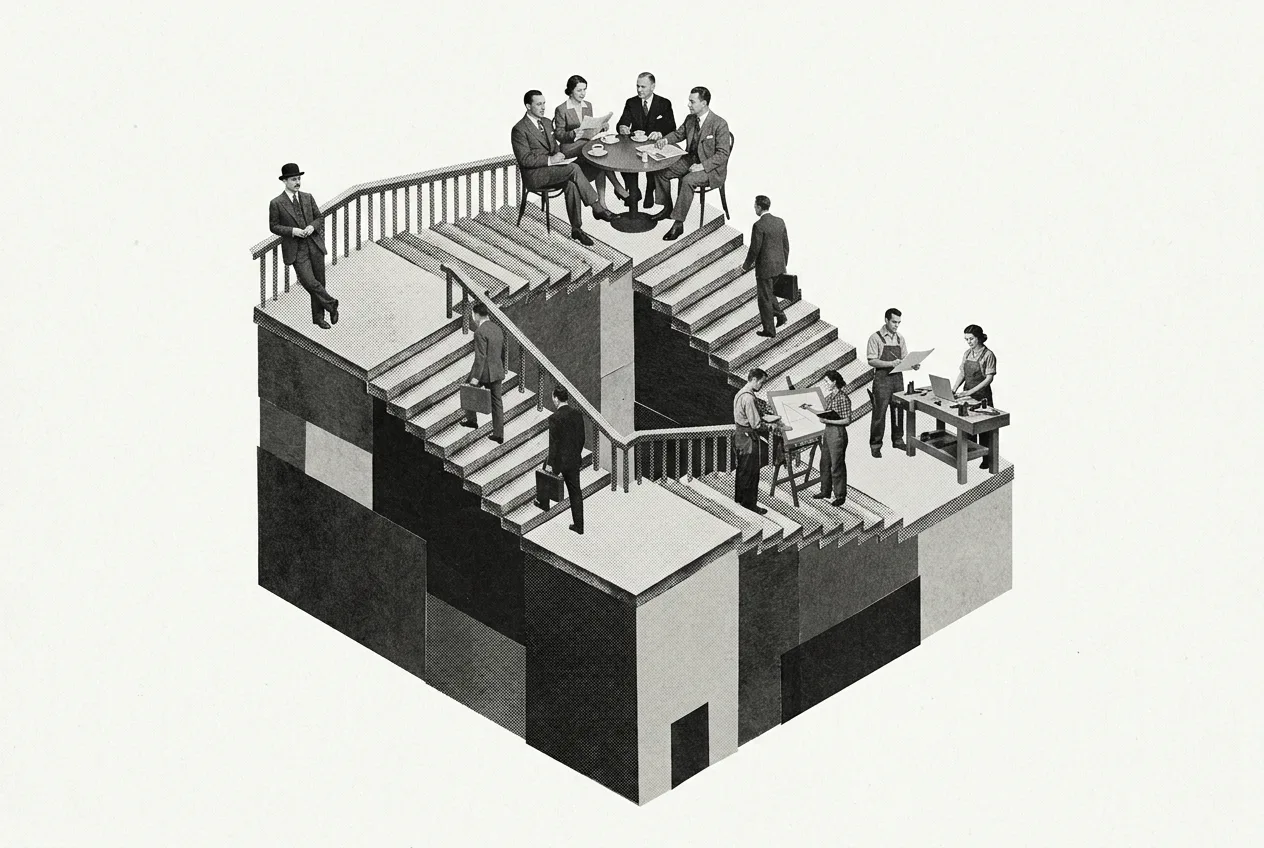
Original editorial illustration generated with AI for this essay.